
Christmastime Metaphysics
Providence, Necessity, and the unfolding of time

The existence of the world cannot be sufficiently explained by reference to Providence alone, as nothing transient and relative can amount to more than a pure contingency. Nor, however, could it be any more accurate to reduce it entirely to passive necessity, as without being sustained by some kind of order, it would lack all intelligibility, lack all coherence, and be so unstable as to prevent its realisation from the offset.
Yet Hinduism does not favour either of these points of view when it attributes the unfolding of manifestation in equal part to Puruṣa and Prakṛti, nor does Taoism in seeing Yin and Yang in all component things, nor even those philosophical schools of the Middle Ages that spoke of ‘God’ and ‘Nature’ as though they were complementary terms.
To these two ‘poles of manifestation’, Guénon assigns the names ‘Essence’ and ‘Substance’, describing Substance as pure potentiality1, lacking a positive existence in itself, and Essence as a particularised expression of the Principle, a positive and direct reflection of the absolute in manifestation2.
Essence therefore expresses, in the relative way proper to its own level, the nature of the Supreme Principle, the only true Knower, which realises the entirety of total Possibility as a Knowledge of Its Self. In that case, we might explain the relationship of Essence and Substance, and therefore of Providence and Necessity, as something like this: all that can be ‘experienced’ or ‘known’ is realised by the very fact of its possibility3, but it cannot be known if not by a knower, around whom it revolves, falling into place in order to become intelligible and assimilable.
We could perhaps illustrate this point more effectively through the use of geometrical symbolism. If we imagine a point which expands indefinitely in all directions to form a 2D plane, the lines comprised in this plane will extend further and further away from this central point, yet nonetheless, by reference to it, they will remain in harmony with each other. And so, if the point expands equally in all directions, which it must do when this expansion is indefinite, the plane may be thought of as disc-shaped, albeit indefinitely large.
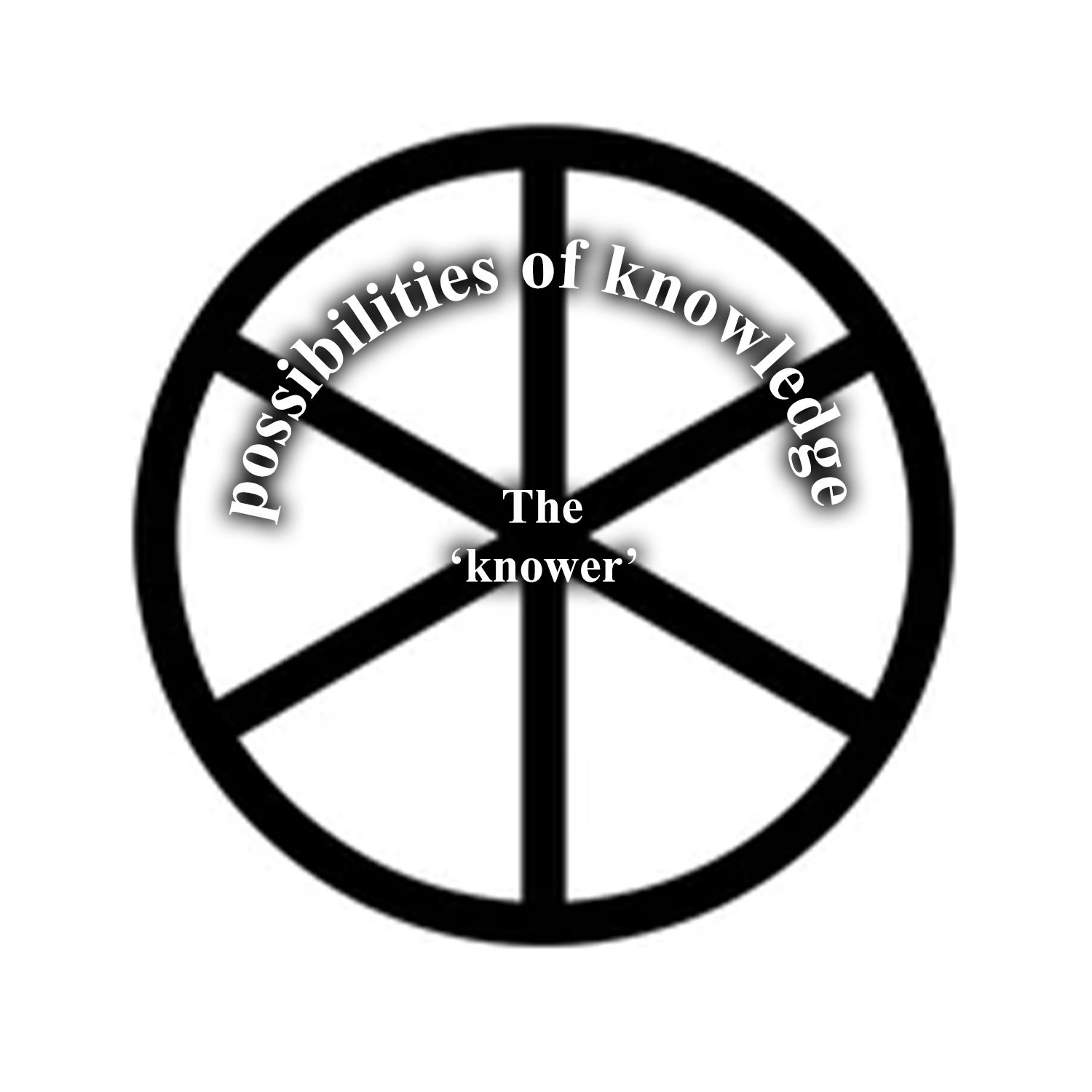
However, the indefinite is merely the product of the finite; without the unit, there could be no sequence of numbers; without the point, there could be no expanse of space, and for this reason, even the indefinite is limited by its very nature. To give a possible example, while the sequence of numbers can always be increased by addition and multiplication, it only exists through its realisation in the world or worlds that accommodate for it4, and its application in these worlds is limited by their finitude. That is to say, while there may not be a ‘highest number’ absolutely, there is still a highest number of things manifested, a number which escapes analysis and is therefore called indefinite.5
It is thus that Guénon, when referring to the geometrical symbolism we brought up previously, is able to say this:
the arrival of these modifications6 at the limit of the circle following the centrifugal radius corresponds to their maximum dispersion, while at the same time necessarily being the stopping-point of their centrifugal movement.7
We now have all the context we need to understand the principles that govern the unfolding of time in our world. In the beginning, the harmonising influence of Essence, which reflects the total Equilibrium of the Principle, exerts itself to the greatest possible extent, before the outward development of things causes its gradual extenuation; with increased dispersion comes increased disorder, and the multiplication of possibilities becomes the foundation of disunity.
Yet, as we stated at the beginning of this essay, nothing can exist without being governed by a higher order, and, as such, from the beginning to the very end, time remains in harmony with cyclical laws. This is the case even when it reaches the ‘stopping-point of its centrifugal movement’ and is reabsorbed into the principial darkness of non-manifestation, a darkness reflected by night in the diurnal cycle. It’s during the night that, following the law of inverse analogy, the ‘spiritual sun’ passes through the heavens, reaching its zenith at midnight.
In the annual cycle, the time of the long night corresponds to the limit of the sun’s southward descent and its subsequent reversal of direction.
The celebration of Christmas occurs during one of the longest nights of the year. Night being synonymous of darkness, it carries a superior meaning along with every symbol when considered from the metaphysical perspective and does indeed particularly symbolize the principle state of non-manifestation.8
The southward course of the sun that lasts from the summer solstice to the winter solstice is, for the Hindus, an inauspicious time of year, corresponding to instability, decline, and the so-called ‘path of the ancestors’, the path followed by those departed souls destined for a return to the bondage of the world. Inversely, the time of the northward solar ascent corresponds to the immutability of the spiritual ‘pole’ and the ‘path of gods’.
Those who know the Supreme Brahma pass away from the world … at an auspicious moment, during the … six months when the sun travels in the north.
The aspirant who passes away from this world … in the six months when the sun passes to the south … again comes back.9
An identical symbolism existed in Ancient Greece, most notably among the Pythagoreans, who referred to the zodiacal signs of Cancer, where the sun resides during the summer solstice, and Capricorn, where it resides during the winter solstice and Christmas, as the ‘gateway of men’ and ‘gateway of gods’ respectively. Each soul was to pass through one or the other at the time of death, depending on whether it was to ascend to divinity or re-descend and pass through an earthly life once more.
But the ‘gateway of gods’, not restricted to the ascent of men to heaven, also provides a passage for gods entering the world of men. As such, in Mithraism as well as Christianity, the incarnation of divinity is said to occur on Christmas Day, both of these incarnations being witnessed by ‘shepherds’.
The narratives surrounding both are naturally rich in symbolism, but we’ll make special reference to the Christian nativity as it concerns the celebration of Christmas more directly.
Of particular note are the ‘three wise men’, whom Guénon identifies with the bearers of the three ‘supreme functions’, the rulers of the supreme spiritual centre, who regulate the affairs of the earth from its interior. These beings resemble ‘incarnations’ and representatives of the three ‘worlds’ respectively, considered in their integrality. That is, universal corporeal manifestation, the ‘universal soul’, and the universal Spirit.
we can now say that in reality these mysterious personages represent nothing other than the three heads of Agarttha. The Mahānga offers gold to Christ and hails him as ‘King’; the Mahātmā offers incense and hails him as ‘Priest’; and finally the Brahātmā, hailing him as ‘Prophet’, or Spiritual Master par excellence, offers myrrh (the balm of incorruptibility, symbol of Amrita). The homage rendered in this way to the new-born Christ by the authentic representatives of the primordial tradition in the three worlds which are their respective domains, is at the same time, we should clearly note, the assurance of the perfect orthodoxy of Christianity in this respect.10
In addition to this, as concerns the scene of the Nativity, he notes that
The ox and the ass placed on either side of the manger at the birth of Christ symbolise respectively the totality of benefic and malefic forces.11
Which are united in Him, the Principle of all manifest things.
Yet, in addition to that which concerns ‘sacred history’, there is also no shortage of symbolism surrounding Christmas derived from folklore, and this latter has the potential to be similarly, even equally, profound.
The people thus preserve, without understanding them, the debris of ancient traditions sometimes even reaching back to a past too remote to be determined and which is therefore consigned to the obscure domain of ‘prehistory’; and in so doing they function as a more or less ‘subconscious’ collective memory, of which the content has manifestly come from somewhere else.12
An example of this is seen in Santa Claus.
Santa Claus leaves the North Pole at midnight, dressed in red and white (symbolizing the colors of life and purity), and descends down the Axis of the World13 bringing “gifts” to the hearts of many. The “gifts” are placed under a Christmas Tree, with a star at its top, covered with lights and Christmas orbs. The orbs, like the “gifts”, represent the fruits of the Tree of Life. These “gifts” from a metaphysical perspective, are intuitive knowledge of the Incommunicable, revealing itself in the hearts of human beings who have reached the Center of the World, on their inner quest for a sense of eternity.14
The use of the tree in celebrations surrounding the winter solstice likely has ancient origins. The trunk of the tree is itself a symbol of the ‘world axis’, its branches symbolising the diversity of worlds that find their origin and their centre in the same source. It will be seen that this symbolism is not far removed from that of the 2D plane alluded to earlier.
Evergreen trees particularly symbolize immortality, as they stand outside the cycle of death and rebirth which is typically associated to other trees. Pine trees, such as the ones used traditionally as Christmas trees, have a naturally definitive triangular shape starting with a large base and ending with a point at the top. The pine tree has therefore the shape of an upward triangle ∆, which is also traditionally used to symbolize mountains, both examples of an Axis of the World. Heaven is said to be traditionally located at the top of the highest mountain, and it is no surprise that a single large star is often placed at the top of Christmas trees.15
With all these considerations in mind, we can easily justify the unique enthusiasm that accompanies the celebrations held at this time of year; the other days of the year, whatever significance they may have, correspond only to so many phases in the life of our world, while the day of the winter solstice corresponds to its final rapture, the twilight of a world condemned to chaos and the dawn of Harmony.
“The primordial waters, before their separation, are the totality of the possibilities of manifestation, insofar as the latter constitutes the potential aspect of Universal Being, which is properly speaking Prakriti.” (Man and his Becoming according to the Vedanta, Ch.5)
“…the universal plastic principle, which, in Being, is determined as 'substance' (the potential aspect of Being)” (The Multiple States of the Being, Ch.12)
“Heaven, as the 'positive' pole of manifestation, is directly representative of the Principle insofar as manifestation is concerned.” (The Great Triad, Ch.6); cf. Man and his Becoming according to the Vedanta, Ch.5
I aim to clarify this point in the summary of The Multiple States of the Being that I posted on here.
This includes its application in abstract thought; there is a highest number that will ever be conceived of mentally, or digitally, or otherwise.
“These observations will allow us to understand more precisely in what sense one can say, as we did at the beginning, that the limits of the indefinite can never be reached through any analytical procedure, or, in other words, that the indefinite, while not absolutely and in every way inexhaustible, is at least analytically inexhaustible.” (Guénon, The Metaphysical Principles of the Infinitesimal Calculus, Ch.21)
I believe that the considerations put forth constitute a more or less accurate explanation of the limits of the indefinite, but the main thing to note is that these limits exist.
The modifications experienced by an individual that determine its existence in a given state, such as the moments that make up a person's life on Earth, symbolised by the points on a radius.
The Multiple States of the Being, Ch.10
Insight on the Esotericism of Christmas, Gauthier Pierozak, Oriens, 2012
Bhagavad-Gita, 8.24-25
René Guénon, The King of the World, Ch. 4
On the Significance of Carnivals, Études Traditionelles, 1945; Symbols of Sacred Science, Ch.23
René Guénon, The Holy Grail, The Veil of Isis, 1934; Insights into Christian Esoterism, Ch.8
The chimney has stood for the world axis in architectural symbolism since its invention. Before this time, the axis, if not depicted physically, was still symbolised between the hearth and an opening in the roof, a symbolic exit-way beyond heaven.
Insight on the Esotericism of Christmas, Gauthier Pierozak, Oriens, 2012
Ibid.