
Two Lies and the Truth
The world doesn't exist. The world is absolutely real...

Taken in the most absolute sense, the words Equilibrium and Truth simply denote two aspects of the one Reality, and for this reason, if we wish to approach an accurate understanding of absolute Truth, we can safely rule out any conception that involves extremes or polarities.
To put it one way, Truth is neither up nor down, neither hot nor cold, neither moral nor evil.
It’s then no wonder that the Buddha would have wished to establish a ‘middle path’, or that Aristotle could justify such an approach with words like these:
In all things the mean in relation to us is the best, for that is as knowledge and reason bid. And everywhere this also produces the best state. This is proved by induction and reason: contraries are mutually destructive, and extremes are contrary both to each other and to the mean, as the mean is either extreme in relation to the other — for example the equal is greater than the less and less than the greater. Hence moral goodness must be concerned with certain means and must be a middle state.1
We might therefore expect that Truth lie between two opposed extremes, two contradictory opinions which are united in the one reality.
The principial unity in fact demands that there shall be no irreducible opposition; accordingly, though opposition between two terms can indeed exist in appearance and can possess a relative reality at a certain level of existence, it is bound to disappear as such and to be harmoniously resolved, by synthesis or integration, when a higher level is attained.2
An extreme point of view is taken by those who see an irreducible reality in the sensible world, an illogical and short-sighted point of view which leads to an animalistic existence, where all reference to the supra-mundane is cut off.
An equally extreme point of view is taken by those who, not merely denying what they can’t see, deny even what’s right in front of their eyes, equating the outside world to a dream that will cease to exist if they only pretend it’s not there.
The former are consumed by meaningless activity in the external world, placing all their aspirations in things destined to pass by. The latter are consumed by their own minds, neglecting the very real and highly consequential stakes of things that lie outside of it.
Guénon rejects both of these illusions in clear terms:
The existence of multiplicity is illusory with respect to unity, while of course still possessing such reality as its nature allows.3
And this is elaborated by Coomaraswamy as follows:
Empirical truth (apara vidya) is then not absolutely untrue, but merely relatively true, while the absolutely true (para vidya) embraces and resumes all relative truth; seen from the standpoint of our empirical consciousness it is veritably the Real that is reflected through the doorways of our five or six senses, and takes the forms of our imagination. Here the phenomenal world is not without significance, but has just so much significance as the degree of our enlightenment allows us to discover in it.4
To emphasise these points, we will briefly explore both of the errors outlined above.
The ‘materialist’ point of view is especially prevalent in our times; it could perhaps even justifiably be called a purely modern invention. It is often supposed to be an empirical point of view; what can be observed with the senses is affirmed, and what cannot is deemed improbable. In reality, however, it is contrary to all logic and no more justified by empirical experience. For example, in spite of what certain scientists may believe, whatever correspondence may exist between mental experience and cerebral activity, it is fantastical to equate the two entirely. One is experienced internally, while the other is observed from the outside. One comprises images, ideas, and awareness, while the other consists of flesh and electricity.
It is equally absurd to equate sense perception itself with the bodily activity to which it corresponds; no arrangement of matter can account for vision, no quantity of particles can account for the experience of heat.
It took many centuries for this new, ‘quantitative’ mentality to take its hold on people and for such simple truths to start being ignored. Those who are taken with it are sucked in by external phenomena, to the point that they almost forget their own being, and it leads to an experience of the world that’s barely more conscious than the typical experience of the dream state, such that the world is experienced more like a dream by the materialists than by those who really see it as such.
Where materialism doesn’t produce nihilism, it typically gives way to sentimentalism and romanticism instead, as the individual seeks to find meaning in his experience without reference to the transcendent.
But nothing receives meaning from any other source, and to seek it elsewhere is like seeking nourishment from artificial food; for a time it may help to get by, but it’s no replacement for the real thing.
In truth, nothing of meaning can be sought in the external.
Whatever is ‘divine’ is necessarily ‘internal’.5
But it is equally erroneous to reduce the internal to the psychic or even to view the latter as truly internal. While relatively internal in comparison to the corporeal, it is not the true being and mustn’t be mistaken for it, and as long as the being views the world through the lens of individual consciousness, Reality will necessarily appear as something other than himself.
It is often the case that those who fail to realise this turn to their own psyche as an escape from things outside of themselves; seeing the relativity of the outside world, they conclude, against all other evidence, that it must be nothing more than a phantasm, something entirely nonexistent, from which they can escape by merely taking refuge in their own sense of self-consciousness.
Yet this self-consciousness is powerless to truly affect anything outside of itself, at least without resorting to external action, and so they are left disempowered and unhappy, deprived of strength as well as of any sense of the real. Their imaginary safe haven possesses no more constancy than the world they hide from, and they are inevitably met with shock and frustration as reality begins to deconstruct it.
This point of view is especially prevalent among neo-spiritualists, who often see spirituality not as a way to discover and embrace the fullness of Reality, but as an escape route from It.
Their error is summed up well by Guido de Giorgio in the following excerpt:
Confusing the notion of truth with a nebulous and treacherous mysticism, they denied [sensible] Forms while asserting a reality that, like mist, enshrouds things, blurring their contours, rounding their edges, but submerging and preserving them as such. Such a conception is absolutely erroneous and dangerous, for it confounds the human and the divine through ignorance of both, turning the absolute into an amorphous heap and the relative into the confused elements of a confused whole.6
Rather
In man, man is affirmed, and in things, things are affirmed, not outside of man and outside of things, but by truly affirming man in man and things in things, that is, by placing the one and the others in their true light, we arrive at the negation of man and things, and this negation is the affirmation of the reality of God, which we reach precisely through man and things.7
While the human understanding of the world is missing context and distorts its true nature, there would be nothing to distort if the world lacked all reality. And this applies to the individual psyche as much as anything else; although it’s capable of leading the being beyond himself, it’s equally capable of dragging him beneath himself. This is why there are two serpents on the Caduceus of Hermes and why there are two distinct signs of Mercury; the psychic state houses the gate to the heavens side by side with the gate to the underworld.
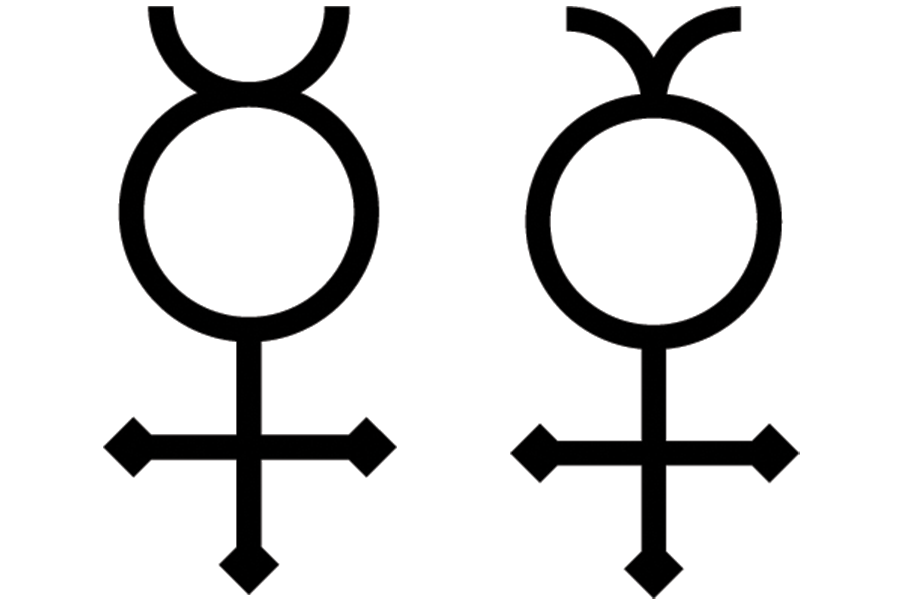
The end goal of all spiritual activity is to achieve a total realisation of all that is, and to hide from things can only be detrimental. If someone truly wished to escape from the contingent, he would need to be prepared to embrace the All. There is no final dissolution of things aside from this total restoration. While the destination is the highest Peace, the journey is a violent struggle.
Order only appears when a standpoint is taken that is above multiplicity and from which things are no longer seen in isolation and “distinctively”, but in their essential unity. This is the standpoint of reality, for apart from its principle multiplicity has only an illusory existence ; but that illusion, with the disorder inherent in it, endures for every being so long as he has not arrived in a fully effective manner (and not merely theoretically) at this standpoint of the “unity of Existence” (Wahdatul wujûd) in all the modes and degrees of universal manifestation.8
To conclude, there is a serious danger for anyone who denies an aspect of reality. If they deny the transcendent, they confine themselves to the lower world, but if they deny the imminent, they can never reach a proper understanding of the Real, at least not before their illusions are destroyed by the course of time. Let us then refrain from ignoring what’s in front of us, and let us apply careful judgement when discerning what’s true and what’s not.
It is true that this world is a nothing in comparison to absolute reality, but we shouldn’t take this as grounds for holding the former in contempt; as long as we are familiar with this world and ignorant of absolute reality, we can only respond to the knowledge of our smallness with awe for the great.
Eudemian Ethics, 2.1220b
René Guénon, The Symbolism of the Cross, Ch.7
The Multiple States of the Being, Ch.6
Buddha and the Gospel of Buddhism, 3.4
René Guénon, The Great Triad, Ch.19
The Roman Tradition, 1.3
Ibid.
The Symbolism of the Cross, Ch.8