
The Cosmogonic Triad
Creation, Preservation, and Transformation

Any living thing, of whatever kind, inevitably undergoes three phases in the course of its existence: firstly, a possibility subsisting in the universal Intellect as an eternal ‘form’ or ‘archetype’ finds its expression in a particular cosmic environment according to its own nature. That is to say, it is ‘created’. Secondly, all the possibilities inherent to that thing unfold one after the other in order of causes and effects. Thirdly, at the moment when all these possibilities have reached their final completion, the living thing (i.e. individual being) is finally dissolved, whence the true being who ‘possessed’ it will proceed to take upon itself some other ‘experience’. In a word, all living things are born, live, and die.
This birth, life, and death necessarily take place by the Will of the Principle, as do all things.
In connection with the divine triads of certain polytheistic religions, we have previously1 alluded to three divine attributes or functions by means of which these processes are effected, and it’s these that we will aim to explore in this article.
The reoccurrence of divine triads, the members of which always bear similar traits, throughout Indo-European religions has been observed by Georges Dumézil, who takes special care in emphasising their connection with the tripartite social division of the Proto-Indo-Europeans, but Guénon cautions against placing too much importance on this point.
It also seems that he tries a little too hard to reduce everything to a social perspective, which risks quite easily leading to a reversal of the real relationship between principles and their applications.2
Bearing this in mind, we can get an idea of Dumézil’s observations in the passage that follows.
The conceptual religious structure which is manifested in these three hierarchized terms is now familiar to Indo-Europeanists. It can be observed, with the special peculiarities of each of the societies, among the Indians and Iranians as well as among the ancient Scandinavians and, with more pronounced alterations, among the Celts… I have proposed, for the sake of brevity, to call this structure “the ideology of the three functions.” The principal elements and the machinery of the world and of society are here divided into three harmoniously adjusted domains. These are, in descending order of dignity, sovereignty with its magical and juridical aspects and a kind of maximal expression of the sacred; physical power and bravery, the most obvious manifestation of which is victory in war; fertility and prosperity with all kinds of conditions and consequences, which are almost always meticulously analyzed and represented by a great number of related but different divinities, among whom now one, now the other, typifies the whole in formulary enumerations of gods.3
Following considerations of a metaphysical order expounded by the Hindu doctrines and discussed by Guénon, we will opt for a slightly different perspective. What Dumézil refers to “sovereignty with its magical and juridical aspects” we will instead relate to the ‘Creator’, who, in his dual aspects of ‘Lord’ and ‘Father’, constitutes the common principle of the regnum and sacerdotium. In place of “physical power and bravery”, we will focus more especially on the transformative force of Death. And we will consider “fertility and prosperity” as gifts bestowed upon humanity by the Preserver or Saviour, who manifests the Good in all things and brings them into Harmony with each other.
We realise that some of the language used here may call to mind other traditional forms than those we propose to deal with, namely, Christianity. The presence of the Holy Trinity in the latter could indeed easily entice us to look for some connection with the triads we’re currently exploring, but we should recall Guénon’s confirmation that
The aspects are not the same in the two cases; in no way can it be said that their differentiation reflects the same point of view; and it is therefore quite impossible to bring the three terms of the one ternary into conformity with the three terms of the other.4
Now, since we intend to discuss cosmogony, beginning from the true First Cause will make certain things much easier to explain further down the line. It goes without saying that all things require some principle for their being (e.g. there could be no colours without light), and it can be deduced that all things must ultimately be derived from the same first Principle. This Supreme Principle will admit of nothing to exist outside of itself and will therefore be totally unconditioned. Consequently, there will be nothing whatsoever that limits universal Possibility - and everything truly possible is necessarily realised by virtue of being such.
Whatever does not happen was not really a possibility, but only ignorantly conceived to have been so.5
We should also establish that, since nothing exists outside of the Supreme Principle, cosmogony cannot truly involve the production of one thing from another separate thing; rather, each product will only ever represent a particular ‘aspect’ of its principle to the exclusion of others, which will amount to nothing more than a privation and limitation of perspective, itself only apparent and in no way affecting the ‘non-duality’ of the Real.
The first of these products of which we can speak is pure Being, or Īshvara.
The consideration of Īshvara therefore already implies a relative point of view; it is the highest of the relativities, the first of all determinations, but it is nonetheless true that it is ‘qualified’ (saguna) and ‘conceived distinctively’ (savishesha), whereas Brahma is ‘unqualified’ (nirguna), ‘beyond all distinctions’ (nirvishesha), absolutely unconditioned, universal manifestation in its entirety being strictly nil beside Its Infinity.6
It is a direct and immediate consequence of universal Possibility, a contingent and infinitesimal element not really distinct from the possibilities of non-being apart from our own conception of it as such. The only possibilities that can really be said to be distinct from each other are those of Existence; that is, Manifestation, the chain of the worlds, the great chain of being, or, in other words, all those possibilities which participate in Being, but are not identified with it.
These are indefinite in number, but the greater part of this indefinitude is made up of supra-formal - or supra-individual - states, such as the pure Intellect, which contains within itself, transcendently, all formal - or individual - worlds and beings, these latter being those which involve ‘life’.
We can thus say that Īshvara creates all living beings through and in the Intellect. But in order to do so, he must ‘become’ manifest as the Trimurti or ‘triple manifestation’, the three intellectual beings under whose guidance all life is created, sustained, and destroyed.
This triad is one of the type which Guénon represents by an upwards-pointing triangle.
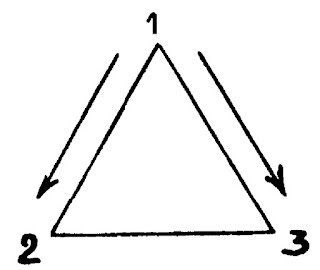
Here, the ternary arises from the polarisation of one principle into two derivative terms, while the first term nonetheless remains unaffected by this polarisation in itself, thus combining with its products to make three.
In the Trimurti, Brahmā is the one from whom Vishnu and Shiva are derived, and he thus encompasses and transcends them both. He is a direct projection of Īshvara and therefore a relative ‘expression’ of the Supreme Principle.
[Brahmā is the] determination of Brahma as effect, kārya7
He is the Creator. Among his equivalents would seem to be Jupiter/Zeus, Mitravarunau, and Óðinn.
He is called Prajāpati, a name expressing ideas related to generation (prajā, cf. ‘progenitor’) and lordship (pati=lord). As Lord, he is often depicted wearing a crown. It is thus no wonder that Jupiter is ‘father of the gods and king of men’.8 Also noteworthy is the Dagda of Irish mythology, who is simultaneously king, druid, and ‘all-father’. He is the archetypal priest-king in whom spiritual authority and temporal power are united.
As Creator, he is also associated with Hiranyagarbha, the ‘cosmic embryo’ or immediate principle of this world. The one who succeeds in identifying his own being with Hiranyagarbha reaches the Brahmā-loka, a realm associated with the primordial state of man, in which the individual assumes the place of the ‘centre of the world’. He can thence proceed further to identify this state with the centre of universal manifestation, around which all of the worlds revolve, and thus become identified with the ‘world axis’.9
Just as the center of each state of a being contains the possibility of identification with the center of the total being, so the cosmic center where Hiranyagarbha dwells is identified virtually with the center of all the worlds: that is to say that for the being that has passed beyond a certain degree of knowledge Hiranyagarbha appears as identical with a higher aspect of the ‘Non-Supreme’.10
The ‘Brahmā-loka’ is thus a point of departure from whence the being identifies himself with ‘Universal Man’.
We will now proceed to discuss the divine function of ‘preservation’ on the grounds that it follows immediately after creation in the course of events, although we have no intention of ranking it above that of ‘transformation’ in terms of importance.
Firstly, it would be impossible for anything to exist in time, indefinitely divisible as it is, without some source of constancy to carry it from one moment to the next; Vishnu is the bestower of this constancy. Among his equivalents would seem to be Quirinus, Pluto, Freja, and Nāsatya.
To better understand this function, it will help to briefly touch upon the nature of the primordial duality, from which results that of stability and instability.
Just as the Supreme Principle is both total Possibility and Infinite actuality, Being is said to have a potential and an actual ‘aspect’. As a result of this, all manifest beings participate simultaneously in two distinct natures, possessing both a ‘substance’ and an ‘essence’. A being’s substance consists of whatever in it exists circumstantially or ‘accidentally’ on account of its being possible, whereas its essence is the direct projection of Being from which it derives all of its reality. As should become clear in light of what has been discussed above, substance cannot have a positive existence in itself and really amounts to nothing more than a limitation of the being’s perspective, ultimately reducible to Essence, with which it is united in Being.
If we accept the Hindu teaching that all experience is simply the self-knowledge of Brahma, we might think of substance as that which is known and essence as that which knows.
Essence participates in the immutability of the Absolute, whereas participation in substance guarantees a state of constant flux. Essence is the source of all order and stability, whereas pure Substance is pure Chaos. All possibilities revolve around Essence as the source of their reality, and it is in reference to Essence that they are brought into Order, thereby becoming ‘intelligible’.11
The ‘actionless activity’ of Essence in the world is known as Dharma, “a principle of conservation of being, and therefore of stability”12
It is this activity, and voluntary cooperation with it, that is referred to by such names as ‘Justice’, ‘Harmony’, and ‘Order’.
This is why all things are said to be ‘good’ in their essence, evil being purely negative and therefore unreal.
Even Satan is still virtually Lucifer, being fallen in grace and not in nature.13
Vishnu is the Principle (here understood as Īshvara) as sustainer of all things and world-preserver, who saves Brahmā’s creatures from perdition through the maintenance of Dharma. He is responsible for all the goodness and beauty in the world, providing these qualities in abundance by maintaining a connection with the One source of all quality.
He rescues humanity from ignorance and death through the gift of Wisdom.
The Matsya-avatara [the first avatar of Vishnu] has yet another aspect which is particularly worthy of note: after the cataclysm, that is at the beginning of the present Maha-Yuga, he brings mankind the Veda, which must be understood, according to the etymological signification of the word (derived from the root vid, to know), as the Science of sciences, or Sacred Knowledge in its entirety. This is a very clear allusion to the primordial Revelation, or to the ‘non-human’ origin of Tradition.14
But regardless,
All conditioned things are impermanent.15
And when a thing has exhausted all of its possibilities, it must necessarily undergo a final dissolution. Whether this takes the form of an active reintegration into and identification with its principle or a passive submergence into the infernal ‘waters’ will depend on the degree of effective knowledge achieved by the individual during its lifetime. This will consist to a large extent in the sacrifice of his own sense of individuality, through which he achieves ‘death before death’.
If you die before you die, then you won’t die when you die.16
What metaphysics understands by immortality and by eternity implies and demands of every man a total and uncompromising denial of himself and a final mortification, to be dead and buried in the Godhead.17
Whatever the case may be, this death is always and invariably effected by the Principle as Shiva, among whose equivalents would seem to be Poseidon, Mars, Thor, and perhaps Indra.
If Brahmā is responsible for ‘coagulation’, Shiva is responsible for ‘solution’, through which all things return from whence they came, their “principial origin and final destiny”18
Kāla is strictly ‘all-consuming Time’; but by transposition it also designates the very Principle itself insofar as it is ‘destroyer’, or rather ‘transformer’, in relation to manifestation which it reduces to the non-manifested state by reabsorbing it, as it were, into itself.19
In the Kabbalistic terminology, Vishnu is responsible for ‘Mercy’, whereas Shiva is for ‘Justice’.
Both Shiva and Poseidon, the god of earthquakes, hold tridents. The trident is a symbol of the ‘triple time’, in which past and future are united in the eternal present. Shiva is said to contemplate this eternal moment with his ‘third eye’, one glance from which is sufficient to efface (or ‘destroy’) the entirety of manifestation.
From the point of view of Life, it is our passive bondage to ignorance and mundane existence that can truly be called ‘death’. It is this condition that ensures a being’s repeated birth, life, and death, or growth, decay, and transformation, again and again through a series of endless cycles until he manages to free himself. It is an unavoidable fact that the experience you and I have of individual existence - a consequence of the insufficiency of our knowledge - will at some point come to an end. Whether we pass through the ‘gate of the heavens’ along the ‘path of gods’ or the ‘gate of the underworld’ on the ‘path of ancestors’ will depend, perhaps more than anything, on our willingness to sacrifice our own selfhood, doing away with all that in us is passive and exchanging our fickle and arbitrary individual desires for the immutable and eternal Will of heaven. After all,
The final purpose of life is to be, not a passive subject, but ‘all in act’.20
Reviews, review of Georges Dumézil — L'Héritage indo-européen à Rome
Archaic Roman Religion, 1.2
The Great Triad, Ch.1
He is referring here to the Christian Trinity and Hindu Trimurti, which latter we will also deal with especially in this article.
Ananda Coomaraswamy, What is Civilisation and other Essays, Ch.9
René Guénon, Man and his Becoming according to the Vedanta, Ch.1
René Guénon, Man and his Becoming according to the Vedanta, Ch.13, where the following note is included:
“It must be pointed out that Brahmā is a masculine form while Brahma is neuter; this indispensable distinction, which is of the highest importance (since it expresses the distinction of the ‘Supreme’ from the ‘non-Supreme’) cannot be indicated if as is usual among orientalists, one employs the single form of Brahman, which belongs to either gender; the latter practice leads to perpetual confusion, especially in a language like French where the neuter gender is wanting.”
Aeneid, passim
See René Guénon, The Symbolism of the Cross
René Guénon, Man and his Becoming according to the Vedanta, Ch.21
For more on this, see my Christmastime Metaphysics
René Guénon, Dharma, The Veil of Isis, October 1935
Ananda Coomaraswamy, What is Civilisation and other Essays, Ch. 2
René Guénon, Some Aspects of the Symbolism of the Fish, Études Traditionelles, 1935; Symbols of Sacred Science, Ch.24
Dhammapada, 277
Epigram from the gateway of Mt. Athos Monastery in Greece
Ananda Coomaraswamy, What is Civilisation and other Essays, Ch. 2
René Guénon, The Multiple States of the Being, Ch.18
René Guénon, Kāla-Mukha, Études Traditionelles, Mar-April 1946; Symbols of Sacred Science, Ch.61
Ananda Coomaraswamy, What is Civilisation and other Essays, Ch.8